
Analysis · ISRAEL
NOS op 3 uses controversial 'Greater Israel' map in explainer on Israel's borders
NOS op 3 shows a controversial 'Greater Israel' map and links it to Herzl. An analysis of its origin, meaning and context.
5 October 2026 at 09:18 GMT+3 · 5 min read · Jerusalem (IDT)
Know More
In an explainer video about Israel's changing borders, NOS op 3 discusses the concept of 'Greater Israel'. A map is shown depicting Israeli territory extending across parts of several Middle Eastern countries. The concept is also linked to Theodor Herzl, founder of modern political Zionism.
That presentation calls for historical context. The term 'Greater Israel' has several meanings, while maps showing Israel stretching from Egypt deep into the Middle East also have a history within anti-Israel and antisemitic propaganda.
A controversial map
Maps depicting a supposed future Israel encompassing large parts of Egypt, Jordan, Syria, Iraq and Saudi Arabia have circulated for decades.
One example is in Cornell University's Persuasive Cartography Collection. The university describes such a map as part of the notion that Zionists secretly strive for a 'Greater Israel'. According to the collection, a version of this map appeared in a 1985 Iranian edition of the forged Protocols of the Elders of Zion. Cornell also notes that the precise relationship between this specific conspiracy theory and the original Protocols is unclear.
That distinction matters. The existence of territorially maximalist currents within Zionism or Israeli politics is not in itself evidence of a secret plan to conquer an area from the Nile to the Euphrates. Conversely, the propagandistic use of such maps does not mean that every discussion of Israeli territorial ambitions is therefore unfounded.
The question is therefore which historical claims NOS op 3 attaches to the map shown, and on what those claims are based.
What did Herzl write?
NOS op 3 links the idea of 'Greater Israel' to Theodor Herzl and a biblical conception of the promised land. Relevant context is missing.
Herzl was the founder of political Zionism, but his political project was not primarily based on a theological interpretation of biblical borders.
His 1898 diary does contain a passage mentioning an area "from the Brook of Egypt to the Euphrates". That sentence cannot be ignored. The context, however, is equally essential.
Herzl writes that he spoke with the German Zionist Max Bodenheimer about possible demands. After a description of the area in question and a possible administrative transition, Herzl notes: "These are Bodenheimer's ideas, in part excellent."
This establishes that such territorial ideas were discussed in early Zionist circles and that Herzl viewed parts of them positively. From this passage alone, however, it does not follow that a state from Egypt to the Euphrates was Herzl's worked-out territorial programme, let alone that it in itself proves a continuing political agenda of successive Israeli governments.
That distinction is lost when a historical idea, a biblical text and current government policy are directly connected.
'Greater Israel' has more than one meaning
Moreover, the term 'Greater Israel' does not denote a single, well-defined territorial concept.
Within Israel too, there have been movements advocating territorial expansion or the retention of conquered areas. Historical research also describes the use of maps of Eretz Yisrael by various Zionist movements, which differed considerably among themselves in their views on borders and territory.
In contemporary discussions, 'Greater Israel' is likewise used for different ideas: sometimes for Israel including the West Bank and Gaza, sometimes for more far-reaching territorial claims, and in the most extreme conception for an area reaching far beyond Israel's current borders.
Journalistically, these meanings cannot be interchanged without explanation.
This applies all the more because radical territorial views also exist within Israel itself. Their presence, however, does not yet prove that the most maximalist variant is official government policy.
From historical ideas to current policy
That is where the main journalistic problem with the NOS op 3 presentation lies.
An explainer video may of course devote attention to territorial maximalism, religious-nationalist movements, settlement policy and statements by Israeli politicians. Dutch public broadcaster NOS has itself previously reported that certain right-wing religious groups in Israel speak of a 'Greater Israel', while also noting that this vision is not shared by the majority of the Israeli population.
Prime Minister Benjamin Netanyahu also said in 2025 that he feels "very connected" to a vision of 'Greater Israel', without defining what geographical meaning he attached to the term. NOS itself made that reservation at the time.
Precisely for that reason, precision is necessary.
There is an essential difference between:
- historical territorial ideas within parts of the Zionist movement;
- religious interpretations of biblical land promises;
- present-day annexation or settlement policy;
- statements by individual Israeli politicians;
- and the claim that Israel is executing a hidden government plan to acquire territory from the Nile to the Euphrates.
The latter claim requires separate evidence. The existence of the first four does not automatically constitute such evidence.
Why the map's origin matters
When a journalistic production uses a map that has previously been circulated in propagandistic or conspiracy-theory contexts, that does not automatically mean the journalist subscribes to the same ideology.
It does, however, set higher requirements for sourcing and context.
The viewer must be able to understand who made the map, from which period it dates, which territorial concept it represents, and whether it shows an official Israeli policy map, a historical ideological conception, or an interpretation produced by opponents.
When such an explanation is absent, a visual representation can suggest more certainty than the available historical evidence justifies.
Right of reply
GOD News has asked NOS which source was used for the map shown in the video and how the editorial team substantiates the relationship between the historical passage in Herzl and current Israeli government policy. NOS had not responded at the time of publication. As soon as a response arrives, it will be included in this article.
Conclusion
The history of territorial ideas within Zionism and Israeli politics is real and complex. Contemporary Israeli politicians, too, have made statements that justify discussion of the concept of 'Greater Israel'.
That makes it all the more important to distinguish between historical ideas, religious conceptions, political movements and demonstrable government policy.
When dealing with the most expansive variant — an Israel stretching from Egypt to the Euphrates — caution is also needed because of the long history in which such maps have been used in anti-Jewish and anti-Israel propaganda.
By connecting these different elements without sufficient source context, the NOS op 3 explainer risks presenting a controversial historical conception as a coherent political project.
For an educational production on such a sensitive subject, precisely that distinction is essential.
Trust & Transparency
The Emet Standard →Sources & Documents
Primary sources
- ArchiveNOS op 3 — De grenzen van Israël, uitgelegd (video, 19 September 2026)
- ArchiveCornell University Library, Persuasive Cartography: The PJ Mode Collection — Dream of Zionism. Map of Greater Israel (ID 2424.01)
- ArchiveCornell University Library, Persuasive Cartography: The PJ Mode Collection — Jewish Imperial Ambitions in Palestine and Neighbouring Countries (ID 2411.01)
Interviews & other sources
Verification & Right of Reply
NOS was asked for the source of the map shown and the substantiation of the historical line presented. No response had been received at the time of publication; it will be published as soon as it arrives.
Corrections, Clarifications & Updates
No corrections, clarifications or updates recorded for this story.
Spotted an error? Corrections & Updates →
Reader conversation
Comments
Checking your sign-in…
Read next
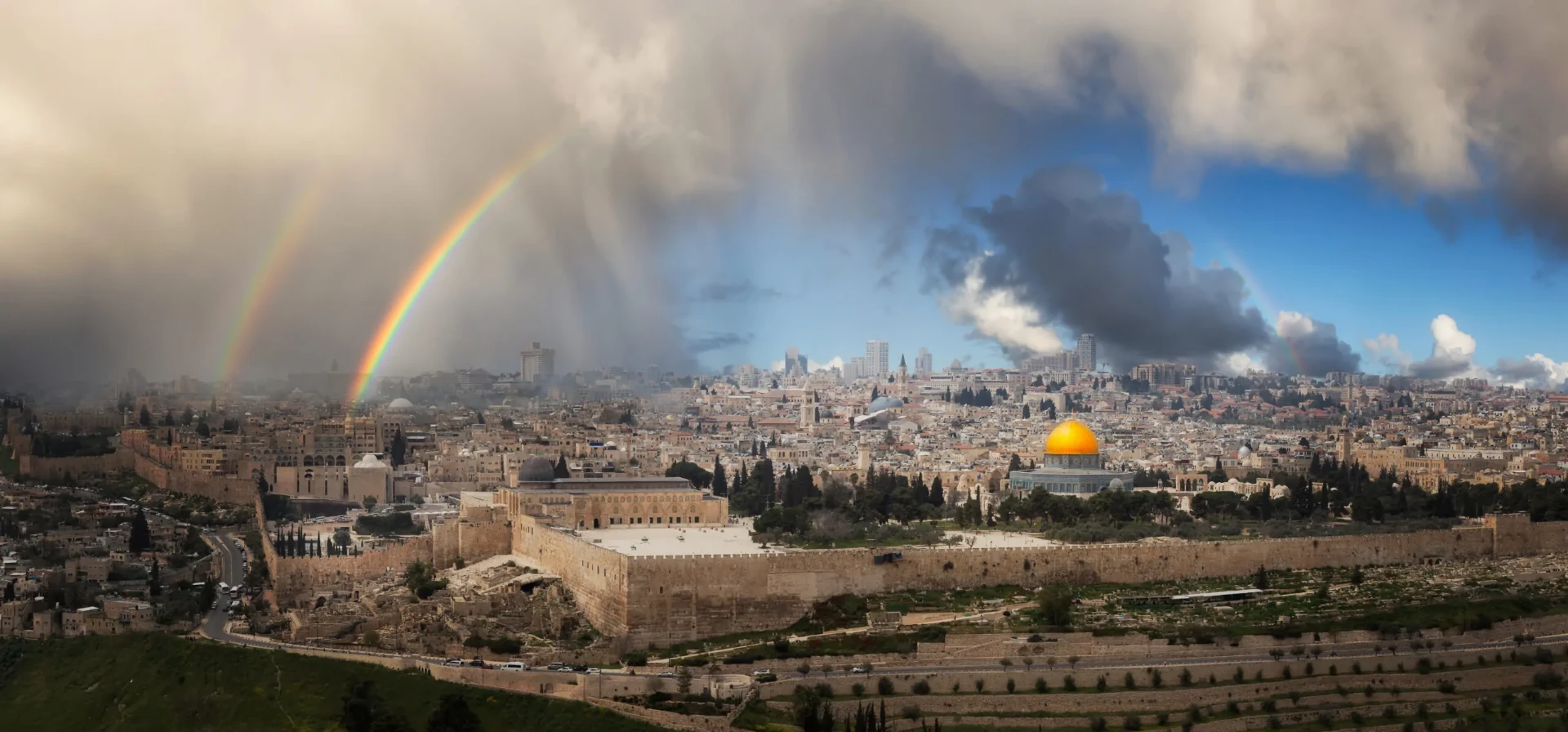
More than 550 Christian leaders from 51 nations gather in Jerusalem for worship and prayer
An international Eagles’ Wings delegation met at the Tower of David during Sukkot, ahead of the third anniversary of the October 7 attacks.

The genocide questions
The word genocide is heard everywhere as an accusation against Israel. Correspondent Henk Folkers puts twenty-five questions to the experts.
Thousands dance with Torah scrolls in Jerusalem, three years after October 7
On the night after Simchat Torah, thousands of Israelis took to the streets of Jerusalem for Hakafot Shniyot — dancing with Torah scrolls at the Western Wall, Liberty Bell Park and the First Station. Three years after the October 7 massacre, the joy carried memory and resolve.
No approved comments yet.