
Faith · FAITH
Faith Without Sight of the Outcome.
Faith becomes visible precisely when you don't yet understand what is happening.
7 October 2026 at 15:29 GMT+3 · 12 min read · Jerusalem (IDT)

The Perspective
There are periods in life when things that seemed self-evident for years suddenly begin to falter. Relationships that are dear to you. Things you have prayed for. Responsibilities you have carried with conviction. Work you have built. Expectations for the future that you thought were more or less fixed.
Sometimes the pressure does not come from a single direction. Sometimes it seems as if several worries converge at the same time. And it is precisely then that faith changes from something you talk about into something that is deeply tested in your heart. Then the question becomes personal: do I trust God even when I don't know how this will end?
I am not writing these words from the comfortable position of someone who now has all the answers. I am writing them in the midst of a period when not everything is clear. There are things I pray for. Things I hope will be restored. Things I want to continue to take responsibility for. And at the same time, I am rediscovering how limited my own ability is to determine the outcome.
Perhaps that is one of the hardest lessons of faith: trusting God is different from being certain that everything will happen exactly as I would like it to.
God has given us great and firm promises. He promises not to forsake His children. He promises to be near to those who seek Him. He promises forgiveness to those who come to Him in Christ. He promises that nothing can separate us from His love in Christ Jesus. He ultimately promises a new heaven and a new earth, where sorrow, death, and pain will not have the last word.
But nowhere does Jesus promise us that life before that day will be without suffering, loss, injustice, or uncertainty. On the contrary.
> “In the world you will have tribulation; but be of good cheer, I have overcome the world.” — John 16:33
Our certainty, therefore, ultimately does not lie in a predictable future. Our certainty lies in Him.
When faith can no longer be a formula
It is relatively easy to say that God is good when life is proceeding smoothly. But what happens when prayers are not immediately answered? When a situation becomes more complicated instead of simpler? When you sincerely try to do good, yet encounter resistance, disappointment, or sorrow?
Then we can unwittingly turn faith into a formula.
- If I just have enough faith, everything will turn out perfectly.
- If I pray enough, God will surely prevent this.
- If I serve God, this will not happen to me.
But the Bible does not speak this way. Joseph walked with God and yet ended up innocently in prison. David was anointed king and yet had to flee for years. Job was described as an upright man and yet faced unimaginable loss. Paul dedicated his life to proclaiming the gospel and knew persecution, imprisonment, rejection, and suffering.
And above them all stands Jesus Christ. Completely without sin. Completely obedient to the Father. And yet His path led to the cross.
Therefore, the measure of God's faithfulness can never simply be whether our circumstances are pleasant. The cross itself teaches us that God's deepest work sometimes occurs at moments when we find it most difficult to understand Him.
“Why, Lord?”
The Bible does not teach us that true faith means we never struggle. The Psalms prove precisely the opposite. David cries out to God. He asks questions. He speaks of fear. He asks how long it will last. He longs for justice and deliverance. And yet he continually brings his heart back to God.
I find that liberating. I don't have to pretend before God that something doesn't affect me. I don't have to use spiritual language to hide sorrow. I may pray: Lord, I don't understand this. I don't know what You are doing in this. I long for restoration. I need Your wisdom. Guard my heart.
> Faith is not pretending the storm isn't there. Faith is knowing where to go in the midst of the storm.
The greatest battle can take place in my own heart
When we experience injustice, loss, or disappointment, there is a danger. Our attention can become so focused on what others are doing that we no longer see what is happening in our own hearts. Pain can turn into bitterness. Fear can turn into a desire for control. Hurt can turn into self-righteousness. The desire for justice can unwittingly transform into a desire for another's downfall.
Precisely for this reason, spiritual maturity requires continuous self-examination. Not just: “Lord, what are others doing?” But also: “Lord, what is happening within me?”
- Do I speak the truth carefully?
- Am I willing to acknowledge my own mistakes? Can I be corrected?
- Do I truly seek peace where peace is possible?
- Am I willing to forgive, even when forgiveness does not mean denying what is wrong?
- Am I acting out of love or out of hurt?
- Do I carry people in prayer, even when our relationship is difficult?
> “Search me, O God, and know my heart.” — Psalm 139:23
That is perhaps one of the bravest prayers anyone can pray in a conflict. For with it, I am not only asking God to change the world around me. I am giving Him permission to change me too.
Our struggle is not against flesh and blood
When people hurt us, it's easy to start seeing them as the enemy. But Paul writes: “For we do not wrestle against flesh and blood.” (Ephesians 6:12)
This does not mean that evil should not be named. It does not mean that injustice should have no consequences. Nor does it mean that a Christian should never make use of legal remedies, boundaries, or protection. Paul himself used his Roman civil rights. But there is a fundamental difference between seeking justice and seeking revenge.
> “Repay no one evil for evil.” — Romans 12:17 · “Beloved, never avenge yourselves.” — Romans 12:19
That is difficult. Perhaps especially when we believe we have good reasons to be angry. But the gospel calls us to a higher way. I may speak truth without hating. I may set boundaries without becoming bitter. I may seek justice without surrendering my heart to revenge. I may grieve and at the same time guard my heart.
Perhaps one of the greatest victories in a difficult period, therefore, is not that all opposition disappears. Perhaps an even greater victory is: that what is done to me does not change me into someone who looks less and less like Jesus.
Habakkuk: even if…
One of the most poignant confessions of faith in the Bible is found in Habakkuk. The prophet describes a situation in which almost every visible source of certainty falls away. No flourishing fig tree. No fruit on the vine. No harvest from the land. And then he says:
> “Yet I will rejoice in the LORD.” — Habakkuk 3:18
That word 'yet' moves me. Not because loss suddenly doesn't matter anymore. Not because pain becomes pleasant. Not because Habakkuk pretends everything is fine. But because he comes to a place where God Himself becomes greater than his circumstances.
Even if I don't understand it — yet. Even if I don't see the solution yet — yet. Even if my prayer is answered differently than I hope — yet I will hold on to God. That is not superficial faith. That is faith that takes root.
Jesus in Gethsemane
Ultimately, I dare not look at my own faith without looking at Jesus. In Gethsemane, we do not see a stoic Jesus who pretends that the coming suffering does not affect Him. He is deeply grieved. He falls down before His Father. He prays that, if it is possible, the cup would pass from Him. And then:
> “Nevertheless, not as I will, but as You will.” — Matthew 26:39
There we see something I increasingly want to learn. Jesus does not hide His desire from the Father. But He also does not make His obedience dependent on the desired outcome. That is surrender.
Surrender, then, does not mean: I no longer care. Surrender means: Father, You know how much I long for a certain outcome. I bring it to You. I will do what You give me to do today. But ultimately, I want to trust You more than my own understanding. That prayer can hurt. But perhaps true freedom also begins there.
I don’t just want to come out of the storm — I want to be more like Jesus
In difficult periods, our first question is understandable: how do I get out of this? But perhaps God also wants to teach us another question: who am I becoming as I go through this? For even when circumstances eventually change, something precious can happen in our hearts in the meantime.
> “Tribulation brings about perseverance; and perseverance, proven character; and proven character, hope.” — Romans 5:3-4
James also speaks of the testing of faith producing perseverance. Not because suffering in itself is good. But because God is mighty to use even that which hurts us to bring us closer to Christ.
Therefore, I don't just want to pray: Lord, get me out of this. I also want to learn to pray: Lord, let nothing of this period be lost. Teach me obedience. Teach me gentleness. Teach me courage. Teach me to speak truth in love. Teach me to forgive. Teach me to discern when to speak and when to be silent. Teach me to bear responsibility without thinking I must control everything myself. And above all: make me more conformed to Jesus.
Peace before the situation changes
Paul writes from circumstances that were anything but comfortable: “Be anxious for nothing, but in everything by prayer and supplication, with thanksgiving, let your requests be made known to God.” (Philippians 4:6) And then there isn't immediately a promise that every situation will be resolved. Something else follows:
> “And the peace of God, which surpasses all understanding, will guard your hearts and your minds in Christ Jesus.” — Philippians 4:7
I sometimes think: if this situation is resolved, I can have peace again. But God's peace works differently. He can give peace while there are still questions. Peace while you are still waiting. Peace while you still have to act. Peace while you still have no certainty about tomorrow. Not because the circumstances are safe, but because your heart continually learns to rest in Christ.
I don't know how every chapter ends
That is perhaps the most honest confession I can make at this moment. I don't know. There are outcomes I ardently hope for. There are things I continue to pray for. There are responsibilities I want to remain committed to.
Where reconciliation is possible, I want to seek reconciliation. Where truth is needed, I want to speak truth. Where I have made mistakes, I want to have the humility to acknowledge them. Where injustice occurs, I may seek what is just. And where I can do nothing more, I must learn to let go of what I never truly held in my hands.
But one thing I increasingly want to stop doing is judging God's goodness by the outcome of my circumstances. For on Friday, Golgotha looked like a defeat. The tomb seemed final. The disciples could not see what God was doing. But on the third day, Jesus Christ rose from the dead.
That is the core of our hope. Not that every chapter on earth ends as we would have written it. But that Jesus lives. That sin has not won. That death has not won. That Christ is King. And that whoever is in Him ultimately has a future that no human, no circumstance, and not even death can take away.
What if I still lose?
Perhaps that is ultimately the most difficult question. What if a prayer is answered differently than I hope? What if something precious truly changes or is lost? Then I want to be careful with big words. I don't know how I will feel under every future circumstance. Peter also thought he was stronger than he turned out to be.
Therefore, I don't want to say: “I will always remain strong.” I want to say: “Lord Jesus, hold me.” That is ultimately my hope. Not the strength with which I hold Him, but His faithfulness.
> “No one will snatch them out of My hand.” — John 10:28
That does not mean that a Christian knows no sorrow. It does not mean that we will never fall. It means that our ultimate certainty does not rest on our own strength, but on Christ.
Therefore, my prayer is becoming simpler: Lord, I long for restoration. I long for peace. I long for justice. I long to take good care of what You have entrusted to me. But above all: let me stay close to You.
When everything falters
Psalm 46 begins with words that resonate deeply in times of uncertainty: “God is our refuge and strength, a very present help in trouble.” (Psalm 46:1) Therefore, the psalmist then says that he will not fear, even when the earth changes. Note: the Bible does not say that the earth will never move. It says there is a God who does not move.
Perhaps that is ultimately faith. Not that I know exactly what tomorrow brings, but that I know Who already knows tomorrow. Not that I am never afraid again, but that I can go to my Father with my fear. Not that I have all the answers, but that I have Jesus. Not that I can hold onto everything, but that Christ holds onto me.
> Lord Jesus, I trust You. Not because I understand everything. Not because everything feels good. Not because I can control the outcome. But because You are good. Because You are faithful. Because You died for me. Because You rose. Because You live. Because You are the same yesterday, today, and forever.
My hope ultimately lies not in what I possess. Not in what I have built. Not in people. Not in my own strength. Not even in the outcome I pray for. My deepest hope lies in Jesus Christ.
And if everything I have considered my anchor should ever falter, I pray that one truth will become even firmer in my heart: Christ is my firm foundation. I don't know how every chapter ends. But I know Who has the last word.
And therefore I want to continue to pray, to continue to love, to continue to forgive, to continue to obey, to continue to take responsibility, and to continue to hope. Not in myself. But in Him. Jesus Christ alone.
Trust & Transparency
The Emet Standard →Corrections, Clarifications & Updates
No corrections, clarifications or updates recorded for this story.
Spotted an error? Corrections & Updates →
About the author
Bas Emons
Bas Emons is the founder of GOD Media Network and GOD Radio. A broadcast executive and media entrepreneur with over two decades of experience building and directing major commercial radio stations, he recognized a critical void in today’s media landscape: the lack of news reporting that pairs uncompromising journalistic integrity with a deep, faithful understanding of Scripture. With GOD News, he bridges high-level broadcast discipline with a commitment to verified truth, regional context, and an enduring Kingdom perspective.
View profile →Reader conversation
Comments
Checking your sign-in…
Read next

When Faith Keeps Calling.
About trust when answers are delayed: Bartimaeus, God's Word as a foundation, and following Jesus on the road.

Perseverance — remaining steadfast in faith.
Perseverance is continuing when you are tired: standing firm when everything in you wants to sit down.
A Little Boy with Great Faith
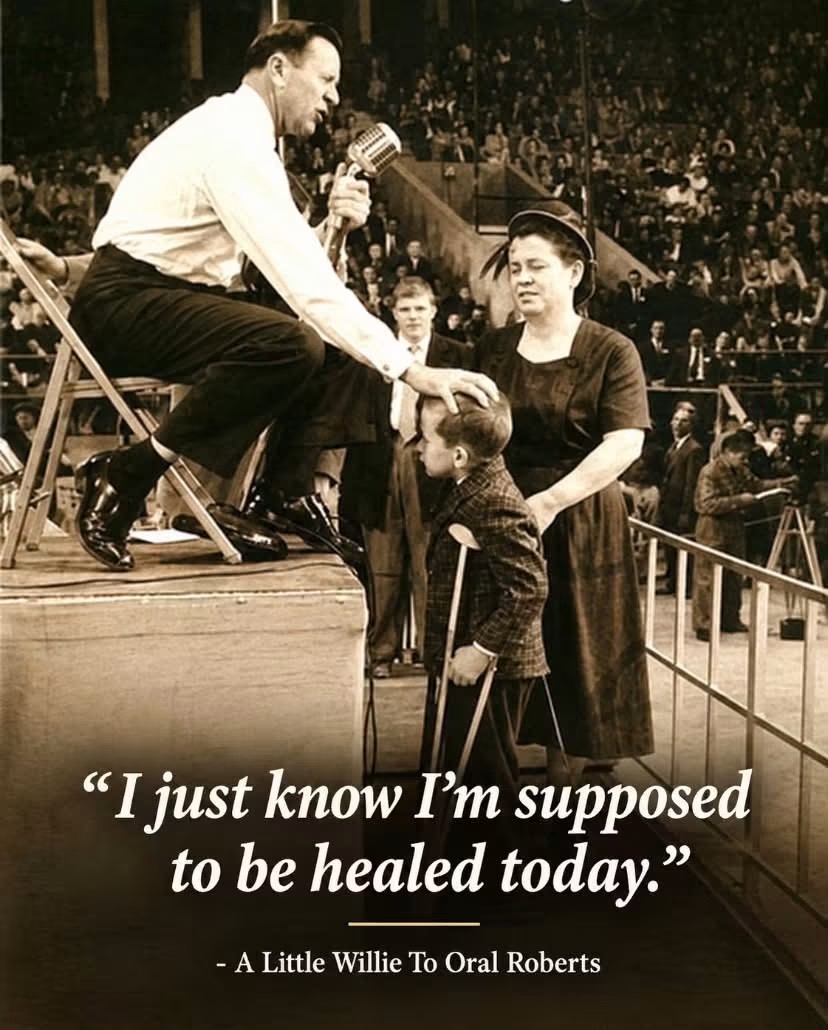
The story of Willie Phelps, the little boy whose great faith led to a miraculous healing through the ministry of Oral Roberts.
No approved comments yet.