
When “I” Sits on the Throne
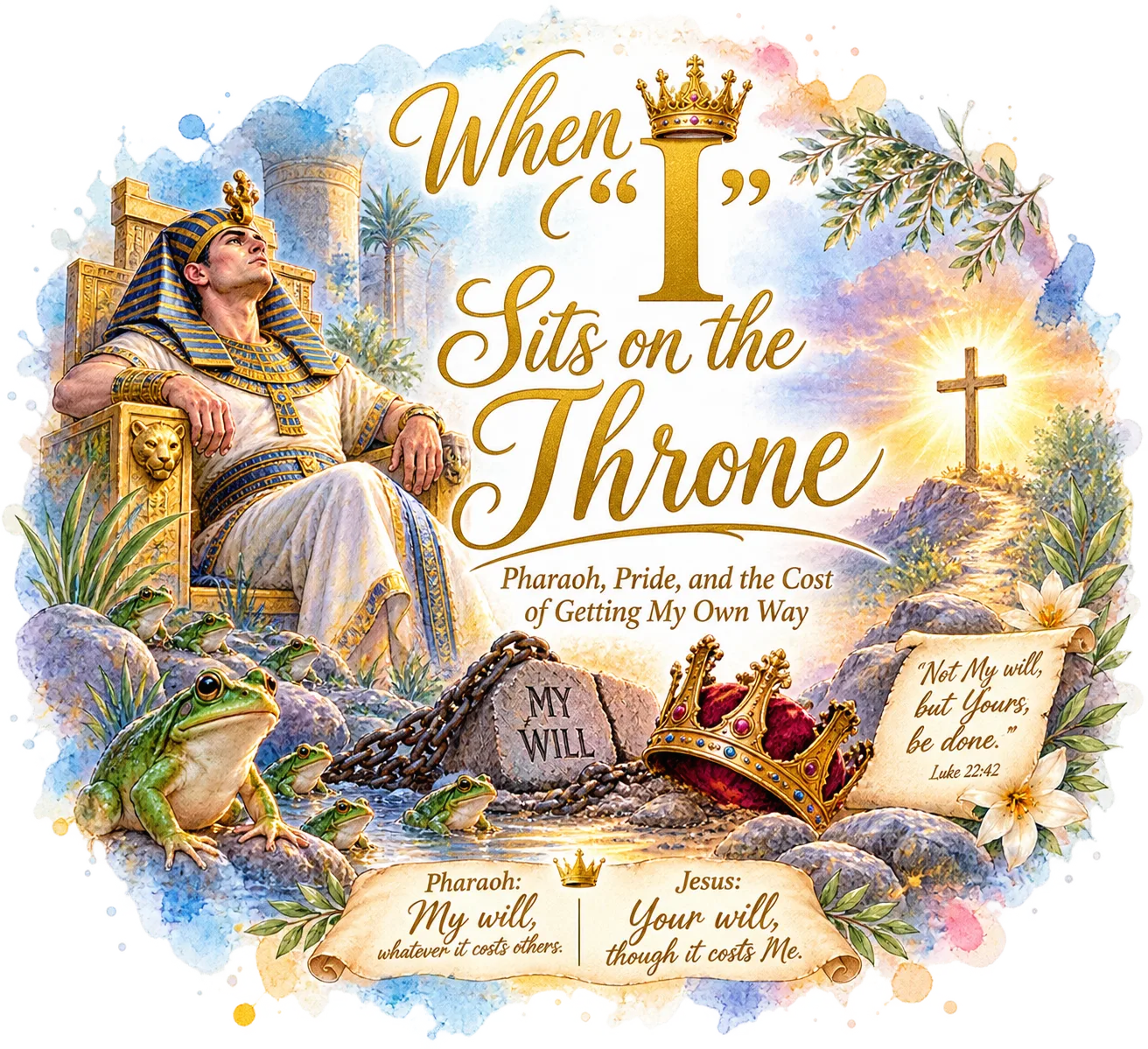
When “I” Sits on the Throne Pharaoh, Pride, and the Cost of Getting My Own Way Last week I, we were laughing about frogs. Thousands upon thousands of frogs. Frogs in the houses.Frogs in the bedrooms.Frogs in the ovens.Frogs everywhere. And then Moses asked Pharaoh when he wanted


When “I” Sits on the Throne
Pharaoh, Pride, and the Cost of Getting My Own Way
Last week I, we were laughing about frogs.
Thousands upon thousands of frogs.
Frogs in the houses. Frogs in the bedrooms. Frogs in the ovens. Frogs everywhere.
And then Moses asked Pharaoh when he wanted them gone.
Pharaoh answered:
“Tomorrow.”
Tomorrow?!
If Moses had asked me when I wanted thousands of frogs removed from my bed, my kitchen, my oven and my house, I like to think I would have shouted:
“YESTERDAY!”
🐸😂
And that ridiculous little moment gave us our first post.
But the more I thought about Pharaoh, the less funny the story became.
Because the frogs were only one plague.
And behind plague after plague stood one man’s refusal to surrender.
One man’s determination to have his own way.
One enormous little word:
I.
“Who Is the LORD, That I Should Obey?”
When Moses first came to Pharaoh with God’s command to let His people go, Pharaoh answered:
“Who is the LORD, that I should obey His voice…?” — Exodus 5:2
There it is.
Before the Nile turned to blood.
Before the frogs.
Before the gnats and flies.
Before the livestock, boils, hail, locusts and darkness.
Before Egypt was devastated.
Before death entered Egyptian homes.
There was this:
Who is God that I should obey Him?
Or, put another way:
Who is going to tell me what to do?
And isn’t that where so much trouble begins?
Not necessarily with some enormous act of evil.
Sometimes it begins quietly inside us:
I want this.
I have decided.
I know what I am doing.
This is what I want to happen.
Nobody is going to tell me otherwise.
My will must happen.
How Much Can One Person’s “I” Cost?
This is what began bothering me as I continued thinking about Pharaoh.
How can one person’s determination to have his own way put an entire nation in the firing line?
Because Pharaoh wasn’t the only one suffering the consequences of Pharaoh’s decisions.
Egypt was.
Ordinary families were.
Servants were.
Workers were.
Parents were.
Children were.
Again and again Pharaoh was confronted.
Again and again there was an opportunity to yield.
Sometimes Pharaoh appeared to soften.
Sometimes he asked Moses to pray.
Sometimes he promised to let the Israelites go.
At one point he even said:
“I have sinned this time. The LORD is righteous, and my people and I are wicked.” — Exodus 9:27
Those are extraordinary words.
But when the immediate pressure passed, Pharaoh returned to resistance.
Again.
And again.
And again.
Until eventually even his own servants could see what his stubbornness was doing.
They pleaded with him:
“Do you not yet understand that Egypt is ruined?” — Exodus 10:7
Imagine that.
Egypt is ruined.
His own people could see it.
And still Pharaoh would not truly surrender.
When We Surround Ourselves With Agreement
That raises another uncomfortable question:
How do we get other people to support us in doing what we shouldn’t do?
Sometimes we surround ourselves with people who agree with us instead of people who will tell us the truth.
Sometimes we keep asking different people until somebody finally gives us the answer we wanted.
Sometimes people around a powerful person know something is wrong but are afraid to oppose them.
Sometimes people benefit from what is happening, so they help maintain it.
And sometimes an entire group can gradually begin accepting something it once would have recognized as wrong.
History gives us horrifying examples of where that can lead.
Hitler is one of the most terrible.
I am not saying Pharaoh and Hitler were identical men with identical motives. They weren’t.
But there is a frightening human pattern worth recognizing.
Hitler’s racist and antisemitic ideology did not remain one man’s private wicked idea. He surrounded himself with people and built a regime that reinforced, promoted and carried out that ideology. Opposition was suppressed. Millions of people participated, complied, remained silent, were persecuted or were swept into the consequences.
The result was catastrophic: the Holocaust, the systematic murder of six million Jews and millions of other victims, and a war that devastated nations.
One man’s “I will” can become enormously dangerous when enough people begin saying:
“We will too.”
And perhaps that should make us ask:
Have I surrounded myself with people who will agree with me—or people who love me enough to tell me when I am wrong?
“I’m Just Determined”
There is another danger.
Sometimes we give stubbornness nicer names.
I’m determined.
I’m standing my ground.
I’m strong-minded.
I know what I want.
I’m not letting anyone push me around.
And sometimes those things genuinely can describe courage.
But sometimes, if we are willing to let God search our hearts, underneath all the respectable words is something much simpler:
I refuse to surrender my will.
And that takes us straight back to the study we were doing before the frogs ever appeared.
Surrender.
We had been looking at Proverbs 16 and discovering that biblical surrender isn’t about making our plans and then asking God to guarantee their success.
“Commit your works to the LORD…” — Proverbs 16:3
We submit our plans to Him.
Our desires.
Our ambitions.
Our expectations.
Our decisions.
Ultimately, our will.
And suddenly I realized:
Pharaoh is almost the negative picture of everything we had been studying.
Not:
Your will be done.
But:
MY will be done.
No matter how many frogs.
No matter what happens to the livestock.
No matter what happens to the crops.
No matter how much Egypt suffers.
No matter how many people around me pay for it.
Until It Reaches Your Own Door
And eventually the consequences reached Pharaoh’s own household.
The firstborn of Egypt died, including Pharaoh’s firstborn son.
Scripture does not tell us what Pharaoh’s wife said or how she responded. It does not describe Pharaoh’s private grief as a father.
We should not pretend to know what Scripture doesn’t tell us.
But we know what the loss of a child means to a family.
We can only imagine the grief inside those homes.
And suddenly something becomes painfully clear:
Sometimes we choose a path of stubbornness or selfishness whose consequences become so enormous that they cannot simply be undone.
And afterward, we—and sometimes people who never made our choice—must live with what our choice caused.
That is frightening.
Because sometimes we behave as though we can always sort everything out later.
I’ll apologize.
I’ll fix it.
I’ll repent.
I’ll deal with the consequences.
But what if we aren’t the only ones who will have to deal with them?
Our spouse may.
Our children may.
Our family may.
Our friends may.
Our church may.
Our community may.
In Pharaoh’s case, an entire nation did.
Repentance Does Not Make Yesterday Unhappen
And this is where we need to understand something important about repentance.
Repentance can change the direction of our future. It does not necessarily erase every consequence of our past.
God can genuinely forgive us.
Completely.
We can genuinely repent.
We can genuinely change.
And still there may be consequences.
Someone can repent of a serious crime and still have to serve a lawful prison sentence.
A criminal record may affect future employment, careers, travel or immigration, depending on the country and circumstances.
Families may be separated.
Relationships may have been damaged.
Trust may take years to rebuild—or may never return in quite the same way.
And sometimes the consequence is physical and permanent.
If someone’s actions result in the loss of a leg, repentance does not ordinarily make the leg grow back.
Forgiveness is real.
Grace is real.
But yesterday does not unhappen.
David gives us a sobering biblical example.
After his terrible sin concerning Bathsheba and Uriah, David finally confessed:
“I have sinned against the LORD.” — 2 Samuel 12:13
Nathan immediately told him that the LORD had put away his sin.
Forgiveness.
But the consequences of David’s actions did not simply disappear.
Consequences.
That distinction matters.
Grace Has Not Run Out
But we must be very careful here.
The Christian message is not:
You ruined everything. Too late. God is finished with you.
No.
There is grace even when consequences remain.
The thief beside Jesus could not go back and rebuild his entire life.
He could not undo everything that had brought him to that place.
Yet the grace of Jesus reached him there.
So if we are standing before the decision, Scripture warns us:
Stop.
Don’t allow the throne of “I want” to become more important than obedience to God.
But if we are standing after the wrong decision, Scripture doesn’t tell us to run from God in despair.
Repent.
Turn around.
Accept responsibility.
Make right whatever can still be made right.
Ask forgiveness where forgiveness needs to be asked.
Repair whatever can still be repaired.
And then trust God with what cannot be undone.
Because:
Grace does not pretend consequences aren’t real. Consequences do not mean grace has run out.
Pharaoh Still Wasn’t Finished
And perhaps one of the most astonishing parts of Pharaoh’s story comes after all of this.
He finally lets Israel go.
Surely now it is finished.
Surely after everything Egypt has endured, Pharaoh understands.
But then Pharaoh changes his mind again.
He takes his army and pursues Israel.
After the blood.
After the frogs.
After the gnats.
After the flies.
After the livestock.
After the boils.
After the hail.
After the locusts.
After the darkness.
After Egypt’s firstborn have died.
Still.
That is what stubbornness can become when it is continually fed.
It is no longer simply:
I really want this.
It can become an inability—or refusal—to surrender even while the evidence of destruction lies everywhere around us.
And that is why I don’t want to finish this story by pointing my finger at Pharaoh.
Because I am not Pharaoh.
You are not Pharaoh.
Very few of us will ever command nations.
But every single one of us has an:
I.
And that brings the story frighteningly close to home.
What Is My “I” Costing Someone Else?
What happens when my insistence on getting my own way begins costing the people around me something?
My marriage?
My children?
My family?
My friendships?
My church?
What happens when winning the argument becomes more important than the person I am arguing with?
What happens when being proven right becomes more important than making peace?
What happens when I know something is hurting the people around me, but I refuse to change because:
This is what I want.
And perhaps the most uncomfortable question of all:
What am I insisting upon today that I may one day wish I had surrendered?
Because there may still be time.
There may still be time to stop.
There may still be time to listen.
There may still be time to obey.
There may still be time to say:
Father, I want this—but I want Your will more.
Two Wills
And finally we come from Pharaoh to Jesus.
In Gethsemane, Jesus prayed:
“Nevertheless, not My will, but Yours, be done.” — Luke 22:42
Jesus did not pretend He had no will.
He expressed His desire to His Father.
But then He surrendered it.
And there is the contrast that has stayed with me through this whole study:
Pharaoh: My will, whatever it costs others.
Jesus: Your will, though it costs Me.
One holds tightly to the throne.
The Other surrenders Himself to the Father.
And perhaps that is why saying:
“Think before you do”
isn’t quite enough.
Thinking is wise.
But thinking can still leave me sitting on the throne.
What do I think?
What do I want?
What seems best to me?
There is something deeper:
Surrender before you do.
Because surrender asks a different question:
Father, what do You want?
And there we are again.
Pharaoh: My will.
Jesus: Your will.
Everything comes back to that throne.
❤️
Jesus & Mimi 19 August 2026
The Prince of Egypt connection places the reader right inside the Moses/Pharaoh story, while the song’s plea for God’s presence brings the emphasis away from Pharaoh’s self-will and toward dependence upon God.
That gives you a beautiful movement:
Pharaoh: I can do this my way. Moses: I need You with me. Jesus: Not My will, but Yours.
And that is precisely where our article ends:
Surrender before you do.
Because thinking can still leave me as the final authority.
Surrender asks: Father, what do You want?
Images from this article
Trust & Transparency
The Emet Standard →Corrections, Clarifications & Updates
No corrections, clarifications or updates recorded for this story.
Related articles
ONE MORE NIGHT WITH THE FROGS
Egypt was overrun with frogs. They were in the houses, the beds, the ovens and the kneading bowls. Then Moses gave Pharaoh the opportunity to choose when they should go. Pharaoh answered, “Tomorrow.” Tomorrow?! 🐸🤣 It is easy to laugh at Pharaoh—until his strange answer turns the

When a Baby said “mama”
When a Baby said “mama” I recently watched a video of two men with a baby. I don’t actually know whether the little one was adopted or whether there were other circumstances, so I won’t pretend I do. I can only respond to what I saw. One of the fathers was encouraging the little
Iran in the Bible: what Scripture actually says about Persia
Iran is not named in the Bible, but the land is. Persia, Elam and Media run through Isaiah, Ezra, Esther, Daniel and Ezekiel — and the way those texts are read still shapes how Christians talk about Iran today.
Reader conversation
Comments
Checking your sign-in…
No approved comments yet.