
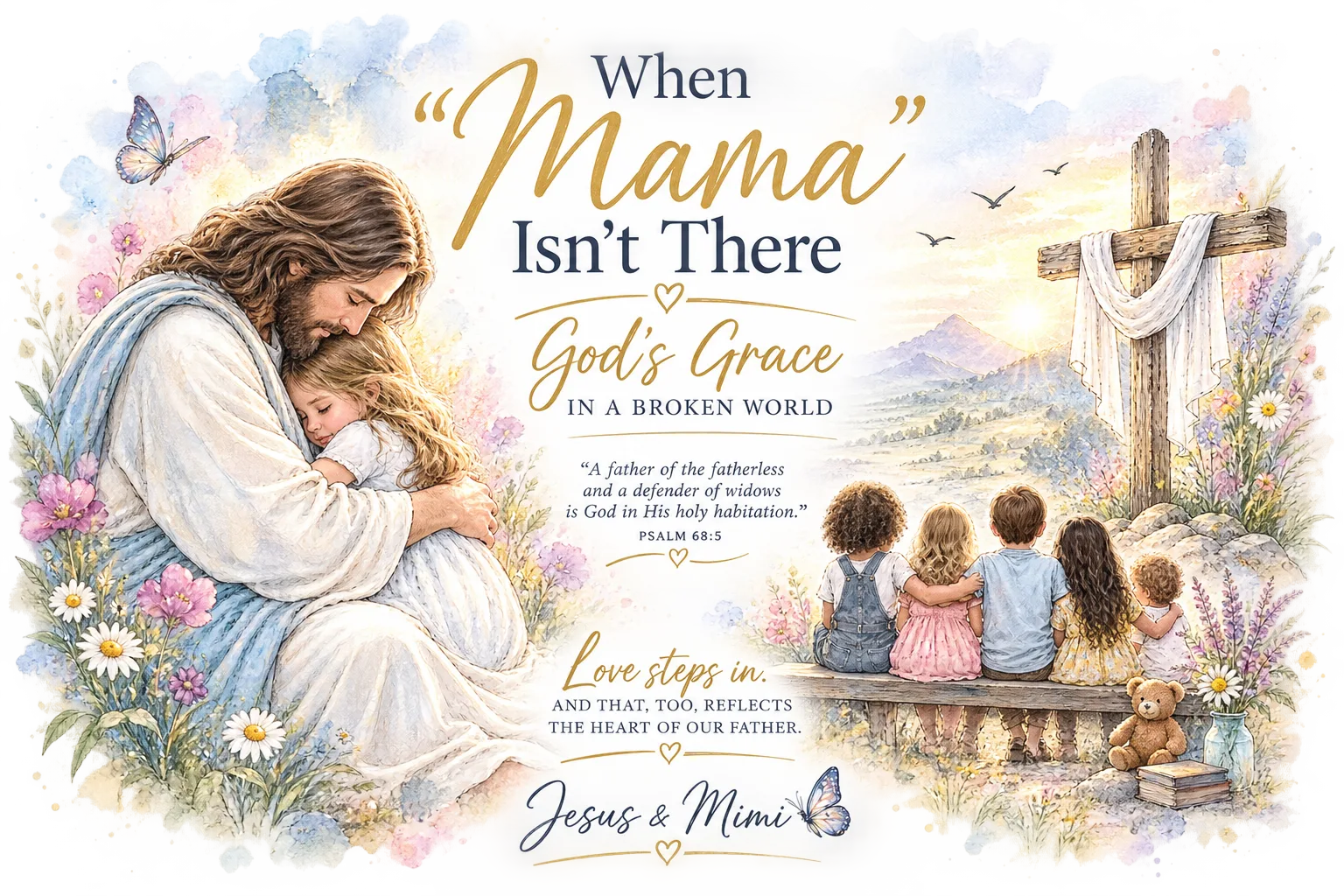
When “Mama” Isn’t There
Sometimes, the person who should have been there simply isn’t. But God is still present in the empty places. And in His mercy, He often sends someone who chooses to stay, to love, to care, and to stand in the gap. The story is not finished.


When “Mama” Isn’t There
God’s Grace in a Broken World
After writing my previous reflection, “When a Baby Said ‘Mama’,” my thoughts didn’t stop there.
That little baby saying “Mama” made me think about something much bigger.
What about all the children in this world for whom Mama simply isn’t there?
There are children growing up without their mothers for countless reasons.
Some have lost their mother through illness or death.
Some through war.
Some through abandonment, addiction, imprisonment, poverty, or circumstances completely beyond their control.
Some are being raised by their fathers.
Some by grandparents.
Some by aunts and uncles, foster parents, adoptive parents, older siblings, or other people who stepped into a child’s life and said, in effect:
“You will not be left without someone to love you.”
And suddenly that little word “Mama” becomes part of a much bigger story.
When God’s Design Meets a Broken World
I believe God’s design for the family is beautiful.
From the beginning, Scripture gives us the pattern of male and female, husband and wife, father and mother.
“So God created man in His own image… male and female He created them.” — Genesis 1:27
“Therefore a man shall leave his father and mother and be joined to his wife…” — Genesis 2:24
I don’t need to move away from that truth in order to have compassion for families whose circumstances look very different.
Because the same Bible that reveals God’s design also reveals something else:
God has an enormous heart for people whose lives have been broken.
“A father of the fatherless and a defender of widows is God in His holy habitation.” — Psalm 68:5
God doesn’t look at the child whose family has been torn apart and say, “Well, that wasn’t My design.”
He draws near.
He cares.
And very often, He provides someone who will care too.
When Someone Else Becomes “Mama”
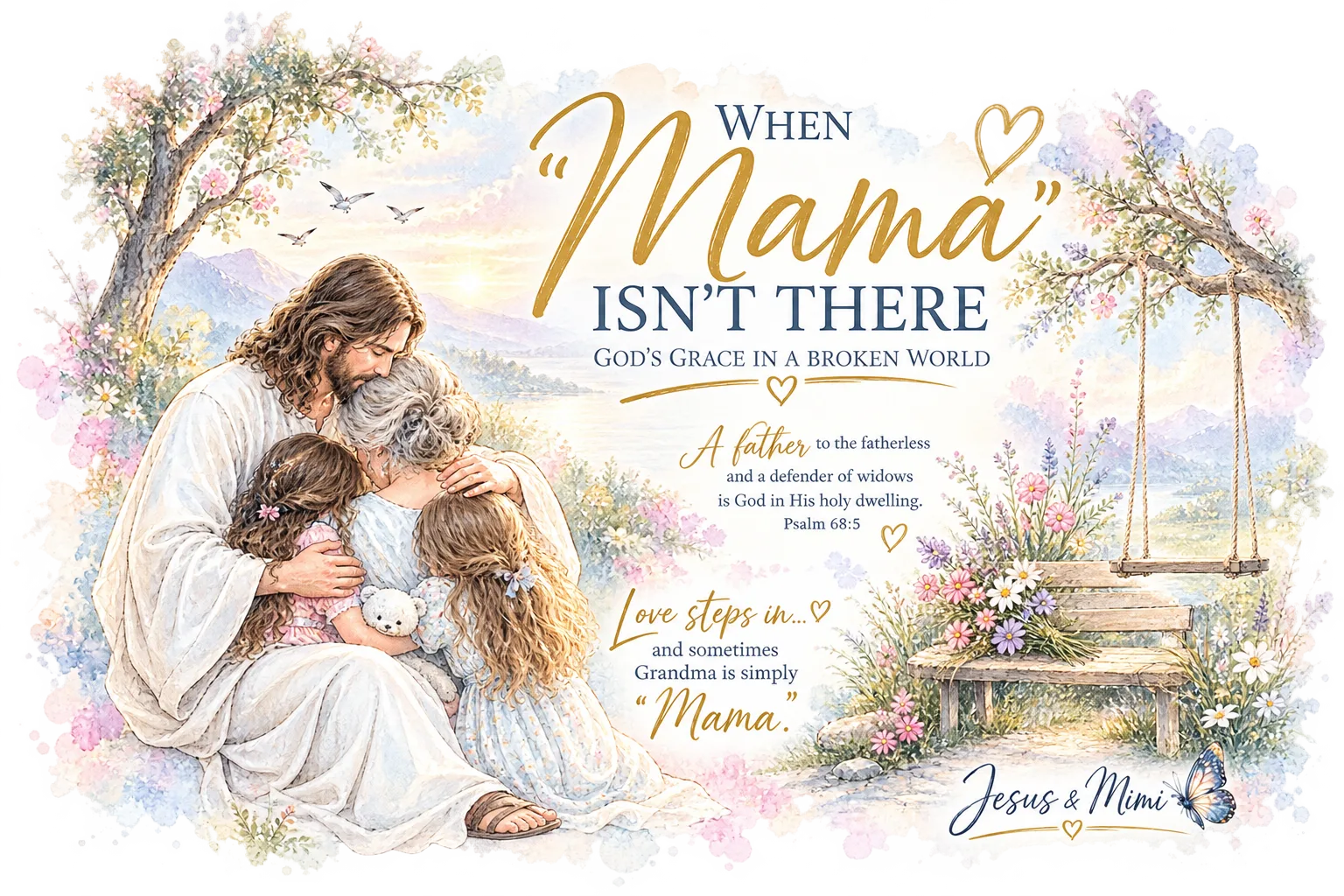
I have a very good friend whose two granddaughters have been in her care since birth.
Because of circumstances, their mother could not care for them and lives in another country. The girls could not go with her, and so their grandparents stepped in.
And they didn’t merely give them somewhere to sleep.
They raised them.
They fed them.
Comforted them.
Protected them.
Took care of them when they were sick.
Celebrated birthdays.
Handled the ordinary everyday things that nobody photographs or applauds.
They simply became the people who were there.
For more than eleven years, their grandmother has been “Mama.”
And I have watched how deeply those grandparents love those precious girls. They do everything within their ability to give them a safe, loving home.
Their story doesn’t make me think God’s design doesn’t matter.
It makes me think about God’s grace when life doesn’t follow the design.
Because sometimes love has to step into a place somebody else was supposed to occupy.
And when it does, I think we should thank God for the person who stepped in.
And Then I Thought About Hannah
There is another mother I cannot stop thinking about.
Hannah.
Oh my goodness, Hannah.
This woman wanted a child so desperately that Scripture describes her weeping before the Lord in “bitterness of soul.”
She prayed:
“O LORD of hosts, if You will indeed look on the affliction of Your maidservant and remember me… but will give Your maidservant a male child, then I will give him to the LORD all the days of his life.” — 1 Samuel 1:11
And God answered her.
Samuel was born.
Can you imagine what it must have been like when she first held him?
The child she had cried for.
The child she had prayed for.
The child she had waited for.
The child who was living proof that God had heard her prayer.
I think I would have wanted to hold him even tighter.
But Hannah had made God a promise.
And when Samuel was weaned, she actually did what she had said she would do.
She took him to the house of the Lord.
Every time I read that, something inside me says:
Hannah… really?!
You prayed for this child.
You waited for him.
God finally gave him to you.
And now you are taking your precious little boy to the house of God and leaving him there?
I can tell you as a mother: I cannot imagine that thought entering my mind for even a millisecond.
I think I would have been saying:
“Lord, surely You didn’t mean literally give him back!” 😅
But Hannah understood something extraordinarily deep.
Samuel had been entrusted to her.
He had never stopped belonging to God.
Listen to her words:
“For this child I prayed, and the LORD has granted me my petition which I asked of Him. Therefore I also have lent him to the LORD; as long as he lives he shall be lent to the LORD.” — 1 Samuel 1:27–28
That wasn’t rejection.
That wasn’t abandonment.
That was surrender.
There is an enormous difference.
She Was Still His Mama
And then Scripture gives us one of those tiny details that I absolutely love.
“Moreover his mother used to make him a little robe, and bring it to him year by year when she came up with her husband to offer the yearly sacrifice.” — 1 Samuel 2:19
Oh, Hannah.
There is Mama.
She had surrendered Samuel to God, but she had not stopped being his mother.
Every year she made her little boy a robe.
I wonder whether she wondered while sewing it:
“Has he grown this much?”
“Perhaps I’d better make the sleeves a little longer.”
I wonder how eagerly she looked for him when they arrived.
I wonder how tightly she hugged him.
Scripture doesn’t tell us those things, so I cannot say they happened.
But Scripture does make sure we know about that little robe.
And I don’t think that detail is meaningless.
Hannah’s surrender did not erase her love.
Her obedience did not make her less of a mother.
She placed the child she loved into God’s hands because she trusted the God who had placed him into hers.
And God had a plan for Samuel that Hannah could not yet see.
That little boy would grow to become one of the great prophets of Israel.
He would hear God’s voice.
He would judge Israel.
He would anoint kings.
He would anoint David—the shepherd boy through whose family line the Messiah would eventually come.
Hannah could not possibly have understood all of that when she brought her little boy to the house of the Lord.
But God did.
Sometimes We Only See the Missing Chair
That makes me think differently about families whose stories don’t look the way we expected.
Sometimes we look at a family and immediately notice who isn’t there.
No Mama.
No Daddy.
No biological parents.
Grandma raising the children.
Dad raising the baby alone.
An aunt becoming the everyday mother figure.
A foster family opening its doors.
And sometimes there is genuine tragedy behind that empty place.
We should never pretend otherwise.
But perhaps we should also ask:
Who did God send to stand in the gap?
Because throughout Scripture, God repeatedly works through people who step into unexpected roles.
Esther lost her parents, and Mordecai raised her as his own daughter.
Moses was separated from his mother and raised in Pharaoh’s household—yet through God’s remarkable providence, his own mother was brought back to nurse him.
Samuel lived away from his mother while Eli oversaw him in the house of the Lord.
And Jesus Himself was lovingly raised by Joseph, who was not His biological father.
Different circumstances.
Different reasons.
Different stories.
But the same sovereign God.
God’s Design Hasn’t Changed—And Neither Has His Compassion
I don’t believe we need to choose between truth and compassion.
We don’t need to alter God’s design in order to love people whose lives don’t fit neatly into it.
And we don’t need to become cold toward complicated families in order to defend biblical truth.
We can say:
God’s design is good.
And we can also say:
Thank God for Grandma who stepped in.
Thank God for the widowed father doing everything he can.
Thank God for the aunt raising her sister’s children.
Thank God for the grandparents starting all over again when they thought their child-raising years were behind them.
Thank God for the foster parent sitting beside a frightened child on the first night in an unfamiliar bedroom.
Thank God for every person who says:
“You may not have the family situation you were meant to have, but you will not face this world without love.”
That does not compete with God’s design.
It is compassion responding to brokenness.
“Pure and undefiled religion before God and the Father is this: to visit orphans and widows in their trouble…” — James 1:27
Maybe “Mama” Is Sometimes the Person Who Stayed
And this brings me back to that little word.
Mama.
For many of us, it means the woman who carried us and gave birth to us.
For another child, “Mama” may be Grandma.
For another, Mama may be gone, and the very sound may carry an ache we cannot see.
And for another baby, “ma-ma-ma” may simply be one of the first sounds those tiny lips are learning to make.
We should be careful about claiming that we know exactly what is happening inside a baby’s heart from one little word.
But we don’t have to speculate in order to recognize something true:
Children need love.
They need security.
They need people who stay.
They need people who protect them, nurture them, teach them, comfort them and point them toward God.
And when circumstances have taken away someone who should have been there, I believe there is something deeply beautiful about the person who steps forward and says:
“Then I will love this child.”
The God Who Steps Into the Gap
Perhaps that is what touches me most.
Because isn’t that something of what God has done for us?
Sin brought separation, loss and brokenness into this world.
But God did not stand at a distance.
He came near.
He entered our brokenness in Jesus Christ.
He pursued us.
He adopted us into His family.
And He became our Father.
“I will not leave you orphans; I will come to you.” — John 14:18
And there is another Scripture that feels especially precious here:
“When my father and my mother forsake me, then the LORD will take care of me.” — Psalm 27:10
What a promise.
Mama may not be there.
Daddy may not be there.
Sometimes neither is there.
But God is.
And sometimes His care arrives through the hands of a grandmother.
A grandfather.
An aunt.
A foster parent.
A family friend.
A father suddenly doing the work of two parents.
Someone who simply chose to stay.
Truth, Mercy and Love
The first time I wrote about that little baby saying “Mama,” I was thinking about God’s design.
This time I find myself thinking about God’s heart.
And I don’t believe the two contradict each other.
God’s design tells us what is good.
God’s mercy tells us what He does when life becomes broken.
And God’s love teaches us how we should respond to the people living inside that brokenness
“Speaking the truth in love…” — Ephesians 4:15
“Mercy triumphs over judgment.” — James 2:13
Hannah surrendered Samuel because she trusted God with the child she loved more than she trusted herself with his future.
My friend’s granddaughters call Grandma “Mama” and Grandpa “Papa” because, through circumstances none of them planned, Grandma became the woman who was there every morning and every night and so did Grandpa become the man who was there every moment to support both the children and the Grandma.
Two completely different stories.
Yet both remind me of something:
Children ultimately belong to God.
We love them.
We raise them.
We protect them.
We pray over them.
Sometimes we even stand in a gap we never expected to fill.
But ultimately we place them into His hands.
Because He sees the whole story when we can see only one chapter.
Hannah couldn’t see the prophet Samuel when she looked at her little boy.
She couldn’t see David’s anointing.
She couldn’t see where Samuel’s obedience would fit into God’s enormous story of redemption.
She simply knew the God who had answered her prayer.
And she trusted Him.
Perhaps that is where I want to leave this reflection.
Not with the missing Mama.
Not with the unusual family.
Not even with Hannah’s extraordinary surrender.
But with the faithfulness of God.
Because families can experience loss.
People can fail.
Circumstances can change everything overnight.
But God remains.
And when “Mama” isn’t there, He still is.
“A father of the fatherless… is God in His holy habitation.” — Psalm 68:5
And sometimes, in His mercy, He sends someone to stand in the gap.
Thank God for the ones who stay.
The story is not finished
— Mimi Jesus & Mimi
Images from this article
Trust & Transparency
The Emet Standard →Corrections, Clarifications & Updates
No corrections, clarifications or updates recorded for this story.
Related articles
ELIJAH — LOOK AT HIS GOD
Elijah’s story is full of fire, courage, miracles, exhaustion, quiet restoration, and the gentle care of God. He was a man with a nature like ours — and through his very human life we see an extraordinary God who answers, nourishes, restores, speaks, preserves, and ultimately poi

When a Baby said “mama”
When a Baby said “mama” I recently watched a video of two men with a baby. I don’t actually know whether the little one was adopted or whether there were other circumstances, so I won’t pretend I do. I can only respond to what I saw. One of the fathers was encouraging the little
But God…
God has always used the unlikely, the ordinary, and even the reluctant. John wore camel’s hair. Jesus came without worldly splendour. Jonah ran from his calling. Yet through each story we discover the same beautiful truth: the power was never in the messenger. It was always in th
Reader conversation
Comments
Checking your sign-in…
No approved comments yet.