
Jesus First
Two familiar verses led to a much deeper question: Is the Christian life about God establishing my plans—or about surrendering them to Him? A journey through Scripture about contentment, strength, truth, authority, and discovering the ri


Jesus First
What Scripture Really Says About
Success, Strength, and Surrender
There are verses in the Bible that are so familiar that we can almost finish them before someone has finished reading them.
“Commit to the LORD whatever you do, and He will establish your plans.” — Proverbs 16:3
And: “I can do all things through Christ who strengthens me.” — Philippians 4:13
Beautiful verses. True verses.
But beautiful verses can become promises God never actually made when we lift them out of their context.
Proverbs 16:3 can begin to sound like: God will make my plans succeed. Philippians 4:13 can begin to sound like:
• I can accomplish anything.
• I can win.
• I can become successful.
• I can achieve every dream.
And as I thought about those interpretations, something began bothering me. There was one little word appearing again and again:
I.
• I can.
• I will.
• My plans.
• My dreams.
• My success.
• My potential.
And it sounded remarkably similar to the message our culture constantly gives us: Believe in yourself. Follow your dreams. You are enough. You can do anything if you try hard enough. But is that really what these Scriptures are teaching? So I opened my Bible. And what began with two familiar verses led me on a much longer journey through Scripture. What I discovered was not that the Bible removes the word “I.” Paul himself says: “I have learned. I know. I can.”
The question is not whether there is an I. The question is: What kind of “I” is speaking? Is it the I that wants to sit on the throne? Or the I that knows Who is already sitting there?
“Commit to the LORD whatever you do…”
At first glance, Proverbs 16:3 can almost sound like this: ” Lord, here is my plan. Please bless it and make it successful”
But something happens when we stop reading verse 3 by itself and begin reading the verses surrounding it.
Proverbs 16 begins: “To humans belong the plans of the heart, but from the LORD comes the proper answer of the tongue.”
Then: “All a person’s ways seem pure to them, but motives are weighed by the LORD.”
Then comes our familiar verse: “Commit to the LORD whatever you do, and He will establish your plans.”
And a few verses later: “In their hearts humans plan their course, but the LORD establishes their steps.” — Proverbs 16:9
Suddenly verse 3 sounds very different. Throughout the passage there are two sides.
We plan. God answers. We evaluate our ways. God weighs our motives. We plan our course. God establishes our steps. Human planning is not condemned. But human planning is placed underneath divine sovereignty.
Roll it onto the LORD
There is something beautiful hidden underneath the English word “commit.”
The Hebrew verb is galal, which carries the basic idea of rolling. The same picture appears in Psalm 37:5: “Commit your way to the LORD; trust in Him…”
There is almost a physical picture here. Imagine carrying something heavy and then rolling that burden onto someone stronger than yourself. So “commit your works to the LORD” isn’t merely: “Lord, please approve what I have already decided.”
It is closer to: “Father, I roll this whole thing onto You.”
• My work.
• My plans.
• My desires.
• My timetable.
• My expectations.
• My reputation.
• My preferred outcome.
Even my right to insist that everything happens exactly as I imagined. That is surrender. And surrender means God is allowed to say: Yes. But also: No. Or: Wait. Or: Not that way. Or: I am taking you somewhere you hadn’t planned to go.
A good plan is not necessarily God’s plan
David gives us a beautiful example.
He wanted to build a house for God. What could possibly be wrong with that? It wasn’t a selfish ambition. It was a beautiful desire. Even Nathan initially thought it sounded right.
But God told David that he would not be the one to build the temple. His son would. David had a good plan. God had a different plan.
Paul experienced something similar in Acts 16. Paul wanted to preach the gospel in certain regions. Surely preaching the gospel must be God’s will! Yet Scripture tells us that the Holy Spirit prevented Paul and his companions from going where they intended and redirected them toward Macedonia.
That teaches us something very important. Sometimes the choice isn’t between: my sinful plan and God’s righteous plan. Sometimes it is between: a good plan and God’s plan.
And they are not always the same.
Jesus and perfect surrender
Then we come to Gethsemane. Jesus expresses a real desire to His Father. Yet He prays: “Yet not My will, but Yours be done.” — Luke 22:42 There is the perfectly surrendered life.
Not: “Father, establish what I want.” But: “Father, Your will.”
Jesus had already described His entire life this way: “For I have come down from heaven not to do My will but to do the will of Him who sent Me.” — John 6:38
And suddenly Proverbs 16:3 is no longer a promise that God will make all my dreams succeed. It becomes an invitation: “Place your life into His hands.” Biblical faith does not ask God to become the servant of my plans. Biblical faith places my plans into the hands of God.
“I can do all things…” Philippians 4:10–13
Then we come to perhaps one of the most quoted verses in Christianity
“I can do all things through Christ who strengthens me.”:
It appears on sports clothing. Posters. Coffee mugs. Social-media posts. And very often it seems to mean: I can accomplish anything if I believe strongly enough. But Paul wasn’t writing a motivational slogan. We have to begin before verse 13.
Paul says: “I have learned to be content whatever the circumstances.” That little phrase stopped me: I have learned. Paul wasn’t born knowing contentment. He learned it. Then he explains: “I know what it is to be in need, and I know what it is to have plenty.” He knows both sides.
• Plenty.
• Need.
• Well fed.
• Hungry.
• Abundance.
• Want.
• Then Paul says:
“I have learned the secret of being content in any and every situation…”
The Greek verb Paul uses for “learned the secret” is myeō. It can carry the idea of being initiated into something—being let into a secret. Life had taught Paul something. And what was the secret? Not: How to escape hardship.
But: How to remain faithful inside whatever circumstances Christ permitted.
The circumstances changed. Christ didn’t.
Paul isn’t saying:
“I trust Christ because eventually He will move me from hunger into abundance.” His contentment cannot depend on receiving the better half of those opposites. Whether abundance comes or doesn’t come: Christ remains Christ.
Whether Paul has much or little: Christ remains sufficient.
Whether his circumstances are comfortable or painful: Christ remains faithful. And only then does Paul say: “I can do all things through Christ who strengthens me.”
Now the verse sounds completely different. Paul isn’t saying: “There is nothing I cannot achieve.” He is saying something much closer to: “There is no circumstance Christ cannot strengthen me to walk through faithfully.”
The secret isn’t: I discovered how strong I am.
The secret is: I discovered where my strength comes from.
The “I” is still there
And this is important.
Paul does say: “I can…” Christianity doesn’t erase the person. It doesn’t remove personality, creativity, responsibility, choice, dreams, work, or calling. The I remains. But the sentence doesn’t end with the I. “I can… through Christ.” The biblical I has been placed into its proper relationship with Christ. The centre of Philippians 4:13 isn’t Paul’s potential.
The centre is: Christ’s sufficiency.
“My grace is sufficient for you” 2 Corinthians 12:7–10
Then Paul takes us even deeper. There was something in his life he desperately wanted changed. Three times he pleaded with the Lord concerning it. God did not give Paul the answer he wanted.
Instead Christ said: “My grace is sufficient for you, for My power is made perfect in weakness.”
Paul wanted the circumstance removed. Christ gave him sufficient grace inside the circumstance. And Paul’s response is astonishing. He says he will boast in his weaknesses so that Christ’s power may rest upon him.
Then: “For when I am weak, then I am strong.”
That sounds contradictory until we understand Philippians 4:13.
Paul isn’t independently strong. His weakness becomes the place where Christ’s strength becomes visible.
The worldly I says:
• Look at my strength.
• Look at my ability.
• Look at my success.
• Look what I accomplished.
Paul’s I says: Look at my weakness… and then look at Christ.
Surrender → Contentment → Sufficiency
Now something begins forming.
Proverbs teaches: Surrender
Commit your works to the LORD.
Philippians teaches: Contentment
I have learned to be content in every circumstance.
2 Corinthians teaches: Sufficiency
“My grace is sufficient for you.”
Surrender → Contentment → Sufficiency.
And God remains at the centre of all three.
Godliness with contentment 1 Timothy 6:6–10, 17–19. Paul then brings us to possessions, money, desire and trust. He says: “Godliness with contentment is great gain.”
The world often defines gain as: more.
• More money.
• More possessions.
• More influence.
• More recognition.
• More status.
• More followers.
But Paul describes another kind of gain: Godliness with contentment. Then comes this sobering reminder: “For we brought nothing into the world, and we can take nothing out of it.”
Everything we accumulate exists inside that little space between arriving with nothing and leaving with nothing. Then Paul writes something that is very often misquoted: “For the love of money is a root of all kinds of evil…”
Notice carefully. Not: Money is the root of all evil. But: The love of money is a root of all kinds of evil.
Those words matter. Money itself is not given a moral personality.
• The issue is love.
• The issue is desire.
• The issue is trust.
The gift or the Giver?
Later in the same chapter Paul speaks directly to believers who are wealthy. Interestingly, he doesn’t tell Timothy: “Command them to get rid of everything because possessions are evil.”
Instead he says: “…not to be arrogant nor to put their hope in wealth…”
There is the real issue.
Where is my hope?
And then Paul describes God as the One: “…who richly provides us with everything for our enjoyment.”
I love that balance. God allows His gifts to be enjoyed. Food can be enjoyed. A beautiful home can be enjoyed. Art can be enjoyed. A wonderful meal can be enjoyed. A cup of coffee can certainly be enjoyed.
The danger begins when: “Thank You, Father, for this gift”
quietly becomes: “I need this gift in order to be somebody.”
Scripture doesn’t teach: Things are evil.
It teaches: “Things make terrible gods.”
We may enjoy God’s provision without putting our trust in His provision.
Rich in good deeds
Paul then tells wealthy believers:
“…to do good, to be rich in good deeds, and to be generous and willing to share.”
What wonderful wordplay. Don’t merely be: rich in possessions.
Be: rich in good deeds. Possessions become stewardship.
The question isn’t merely: “What do I have?” But: “What am I doing with what God entrusted to me?”
And so we discovered three more words: Contentment
God Himself is enough. Desire
I must watch what my heart begins craving. Trust
Contentment Desire Trust
My security belongs in God, not His gifts. Contentment is not having nothing. “Contentment is having Christ whether I have much or little.”
But money isn’t the only thing we can love.
And here Scripture began turning the mirror toward us. Someone may not care about designer clothing. Or expensive handbags. Or jewellery. Or luxury cars. And still struggle deeply with self. Because we can crave things that don’t have a price tag.
• Approval.
• Recognition.
• Control.
• Comfort.
• Attention.
• Being right.
• Being admired.
• Success.
• Followers.
• Influence.
Even ministry influence. Every human heart can find somewhere to build a little throne for I.
And that took us to 2 Timothy. “lovers of pleasure rather than lovers of God.”
2 Timothy 3:1–5 Paul writes: “People will be lovers of themselves…”
Then: lovers of money, boastful, proud, and later: ” lovers of pleasure rather than lovers of God.”
Suddenly we see that the deepest problem isn’t merely that human beings love. It is that our loves become disordered.
• Self takes first place.
• Money takes first place.
• Pleasure takes first place.
• God is pushed aside.
And then comes perhaps the most sobering phrase: “…having a form of godliness but denying its power.” Imagine that. There can apparently still be something that looks religious.
• Religious language.
• Religious identity.
• Religious behaviour.
• Perhaps even religious activity.
• Yet something inside has not been transformed.
There can be: “an appearance of godliness without the transforming reality of godliness.” That is both amazing and terribly sad.
The danger of pointing only at everyone else
And this is where we have to be very careful. It would be terribly ironic to study: “People will be lovers of themselves…” and use the entire passage to demonstrate how much better I am than everybody else. Then the self-centred I would have managed to turn even a warning against self-centredness into self-exaltation.
So the question cannot only be: “Lord, where do I see this in society?” It must also be: “Lord, where is this tendency in me?”
Where does self still want the throne?
Spiritual lifelines
Ephesians 4:17–32 Then we came to Ephesians 4. What an extraordinary passage. It reads almost like a series of lifelines designed to keep believers safe, concentrated and focused upon Christ. Paul speaks about people becoming: “darkened in their understanding…”
He mentions: “the hardening of their hearts.”
And then: “Having lost all sensitivity…”
That progression is sobering. Something that once troubled the conscience can begin to feel ordinary when truth is continually resisted. Paul then tells believers: “Do not grieve the Holy Spirit of God…”
The Holy Spirit corrects.
• Convicts.
• Warns.
• Leads.
And we need those warnings. God’s commands aren’t prison bars designed to keep us from enjoying life. They are more like guardrails keeping us from driving over the cliff.
God sees where the road ends.
When sin begins to feel normal
Paul then warns: “The Spirit clearly says that in later times some will abandon the faith and follow deceiving spirits…”
Notice the movement. They turn away from something. And they begin following something else. Spiritually, human beings don’t remain neutral for very long. When truth is rejected, another voice becomes attractive. Something else may appear greener.
Easier.
• More comfortable.
• More exciting.
• Less demanding.
Something that tells us what we would rather hear. And that brought us to another passage.
Itching ears
2 Timothy 4:1–4 Paul says: “For the time will come when people will not put up with sound doctrine.”
And then he tells us why: “…to suit their own desires…”
There is desire again. They gather teachers who will say what their ears want to hear.
Then: “…they will turn their ears away from the truth and turn aside to myths.”
This is where our study of the I becomes much more serious than:
“Look at me.”
Perhaps one of the most dangerous expressions of the self-centred I is: “I want God to agree with me.”
Instead of approaching Scripture saying: “Lord, change my thinking,”
I can begin approaching Scripture asking: “Where can I find something that confirms my thinking?”
Instead of: “What has God said?”
the question becomes: “What do I want God to have said?”
That is dangerous.
But disagreement isn’t automatically deception
We also need humility here. Not every Christian who misunderstands a passage is following a deceiving spirit. Not every doctrinal mistake means someone has abandoned the faith. Not every disagreement between sincere Christians means somebody has itching ears. Otherwise we could very easily say:
“Anyone who disagrees with my interpretation has itching ears.”
And suddenly I would be back on the throne. Scripture remains the measuring line. Not me.
Which brings us beautifully to the Bereans.
Examine the Scriptures
Acts 17:10–12 The Bereans received Paul’s message with eagerness. But they did something wonderful. They: “…examined the Scriptures every day to see if what Paul said was true.”
Think about that. This was Paul preaching.
And Scripture praises them for checking Paul’s preaching against Scripture. They didn’t believe something simply because an impressive preacher said it.
• They opened God’s Word.
• They examined.
• They compared.
• They tested.
That should be the posture of every believer. “Don’t believe something merely because a preacher said it.”
But equally: “Don’t reject something merely because it makes you uncomfortable.”
• Open the Bible.
• Examine the Scriptures.
• Let Scripture interpret Scripture.
And that is exactly what we have been doing with Proverbs 16:3 and Philippians 4:13. We didn’t throw those verses away when we discovered they were sometimes misused. We put them back into their Bibles. And when we did… they became more beautiful.
Not less.
Prominent Greek women
Acts 17:12 And then one little word caught my attention.
Luke tells us that many believed: “…as did also a number of prominent Greek women and many Greek men.”
Why does Luke tell us that the women were prominent?
The Greek word can describe people who were respectable, influential or of notable social standing. Interestingly, Luke has already mentioned prominent women in Thessalonica earlier in Acts 17. And throughout Luke and Acts, women repeatedly appear as important participants in the unfolding story of the gospel.
• Lydia.
• Priscilla.
• Tabitha.
• Damaris.
• Philip’s daughters.
• And others.
We should be careful not to invent a reason Luke doesn’t explicitly give us for emphasizing the women’s standing here.
But one thing is clear:
The gospel was reaching across social boundaries.
• Jews.
• Greeks.
• Men.
• Women.
• Ordinary people.
• Prominent people.
• The Word was moving.
“These people have caused trouble all over the world
Acts 17:5–9 And earlier in Acts 17, something almost made me laugh. Some of Paul’s opponents become jealous. They gather a crowd. They start a disturbance. They cannot find Paul and Silas, so they drag Jason and some other believers before the city officials. And then comes the dramatic accusation: “These men who have caused trouble all over the world have now come here…”
Another familiar translation describes them as: “These who have turned the world upside down…” They meant it as an accusation.
Reading Acts from the other side of history, it almost sounds like a compliment. The gospel really was spreading. But then comes a very serious accusation: “They are all defying Caesar’s decrees, saying that there is another king, one called Jesus.”
Their framing was hostile. But buried inside the accusation was something profoundly true. There is another King.
His name is Jesus.
What about Caesar?
Christians are not commanded to despise civil authority.
Paul writes in Romans 13 that governing authority exists under God’s sovereign ordering. Peter likewise tells believers to respect legitimate authority. Daniel says: God raises kings up and removes them. Daniel 4 makes the point dramatically through Nebuchadnezzar. Nebuchadnezzar looks over Babylon and says:
“Is not this the great Babylon I have built… by my mighty power and for the glory of my majesty?”
Listen to the language:
• I built.
• My power.
• My majesty.
There is our I again.
Nebuchadnezzar had mistaken delegated authority for ultimate authority.
And God humbled him.
Human authority is borrowed authority
Perhaps one of the clearest pictures appears when Jesus stands before Pilate.
Pilate says: “Don’t you realise I have power either to free You or to crucify You?” In other words: Do You understand who I am?
And Jesus answers: “You would have no power over Me if it were not given to you from above.” — John 19:11
Pilate genuinely had authority. Jesus didn’t pretend otherwise. But Pilate misunderstood where that authority came from. And standing in front of Pilate was the One whose authority infinitely exceeded his.
So Scripture gives us a beautiful balance:
• Human authority is real.
• Human authority is delegated.
• Human authority is limited.
• Human authority is accountable.
• God’s authority is ultimate.
When earthly authority conflicts with God’s authority
Because government exists under God, believers ordinarily respect and obey legitimate civil authority.
But earthly authority cannot claim what belongs exclusively to God. That boundary appears clearly in Acts 5: “We must obey God rather than human beings!” We see it with the Hebrew midwives in Exodus.
Pharaoh commands something wicked. They refuse because they fear God. We see it in Daniel 3. The king commands worship. Shadrach, Meshach and Abednego refuse. We see it in Daniel 6. Daniel continues praying to God despite the royal decree. They don’t deny that earthly rulers possess authority. They recognize that there is a King above the king.
So we can say:
Respect earthly authorities because God has ordained human government, while remembering that every earthly authority remains under God’s sovereign authority and accountable to Him.
Caesar may be emperor. But Caesar is not Lord.
There is another King — Jesus
And suddenly Acts 17 becomes enormously important to our study. The accusation was: “…there is another king, one called Jesus.” On the deepest level… that was true. Christianity does not merely proclaim: “Jesus can help improve your life.”
Christianity proclaims:
Jesus Christ is Lord.
And if Jesus is Lord, then neither Caesar nor I can occupy His throne.
The throne belongs neither to “I” nor to Caesar
Now everything begins coming together.
We started with: “God will establish my plans.”
But Scripture kept moving the throne.
Proverbs says: “Commit your works to the LORD.“
Philippians says: “Christ strengthens me.“
2 Corinthians says: ” His grace is sufficient.‘
1 Timothy says: ” Don’t put your hope in wealth.“
2 Timothy says: ” Don’t become a lover of self rather than a lover of God.“
Acts says: ” Examine everything against Scripture.“
Acts 17 says: “There is another King — Jesus.“
And so the message isn’t:
ME + God’s help.
It is:
CHRIST IS LORD.
And I surrender to Him.
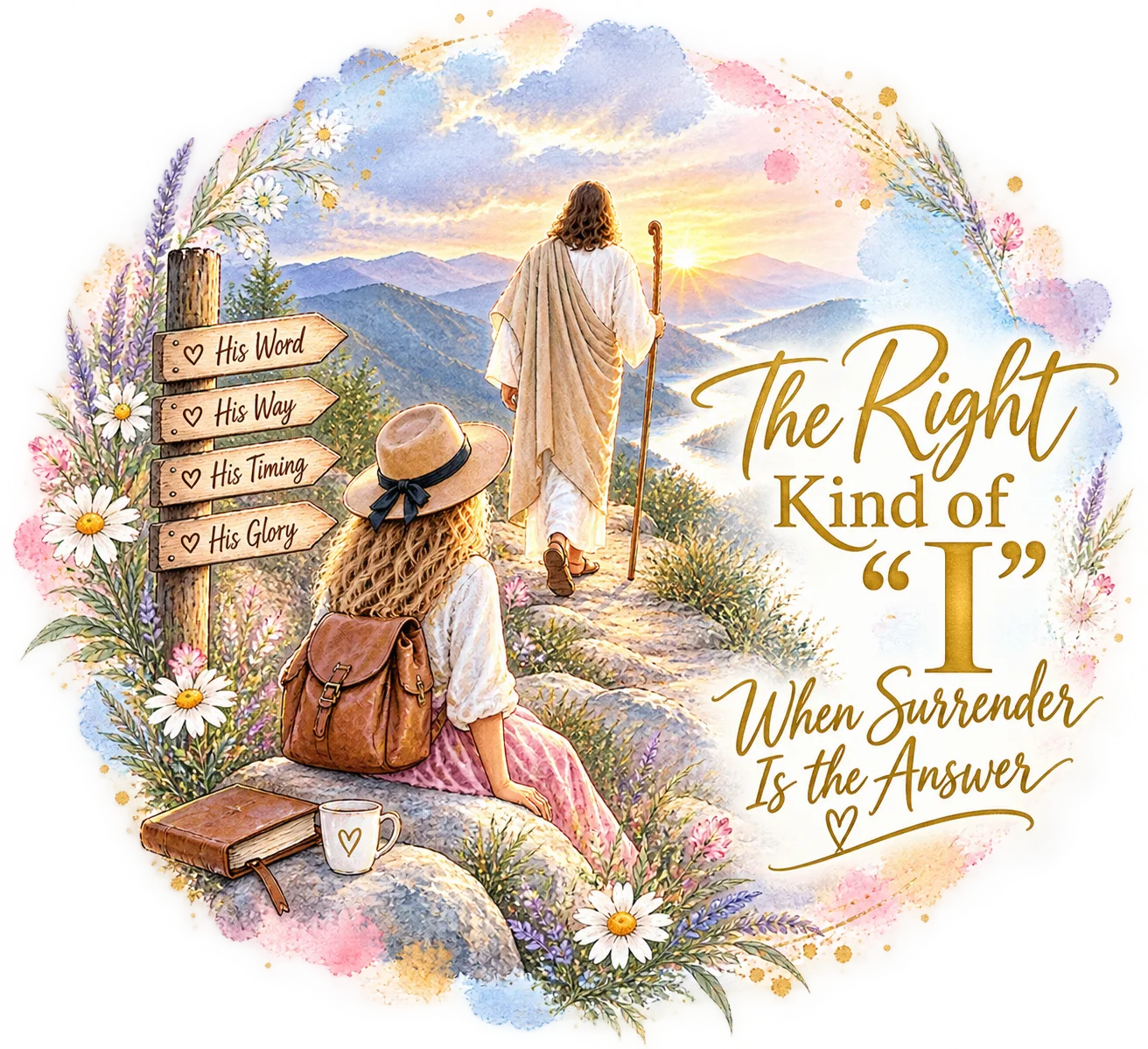
The right kind of “I”
And this is where something beautiful happened in this study. I realised: The problem isn’t actually the word “I.”
There is a selfish I.
It says: I determine my way.
• I am sufficient.
• I decide what is true.
• I deserve the glory.
God should establish what I want. That I want’s the throne. But Scripture gives us another I.The I of discipleship.
It says: I follow. I learn. I listen. I surrender. I depend. I obey. I trust. I worship. The first I want’s to sit on the throne. The second I know’s Who is sitting there.
Why “Jesus & Mimi”?
And suddenly I realised that this is the very reason my blog is called:
Jesus & Mimi
Not: Mimi & Jesus.
Because the order matters.
Jesus first. Mimi follows.
He leads; I follow. He teaches; I learn. He speaks; I listen. He corrects; I surrender. He strengthens; I depend. He commands; I obey. He is faithful; I trust. He receives the glory; I worship.
There is an I in every one of those sentences. But it is a completely different I. The I hasn’t disappeared. It has simply stepped down from the throne. And perhaps that gives us the simplest sentence from this entire study.
And, I-ronically…
After spending all this time thinking about the danger of the self-centred “I,” I realised something that made me laugh.
I-ronically, the lesson was never that the “I” had to disappear at all.
It simply had to learn its proper place.
Not: I lead. Jesus follows.
But: Jesus leads. I follow.
Perhaps that little “I” wasn’t the problem after all.
It just needed to get off the throne. 😄
Jesus first. I follow.
God has given us personalities.
• Creativity.
• Gifts.
• Responsibilities.
• Families.
• Homes.
• Work.
• Dreams.
• Plans.
• Ideas.
He hasn’t called us to become people without desires or initiative. But everything belongs beneath His Lordship.
My plans. My desires. My home. My family. My possessions. My ministry. My strength. My weakness. My future.
Everything.
So now, when I read: “Commit to the LORD whatever you do, and He will establish your plans…” I no longer hear: “God will make whatever I want succeed.”
I hear: “Roll it onto Me.” And when I read: “I can do all things through Christ who strengthens me…” I no longer hear: “I can achieve anything.” I hear: “Whatever Christ calls me to walk through, He will be sufficient.”
And when the world continually whispers: “Look at me.”
May my life quietly answer:
“Look at Him.”
Because the order matters.
Jesus & Mimi
Jesus first.
Mimi follows.
And Jesus receives the glory.
Soli Deo Gloria. ❤️
Images from this article

Trust & Transparency
The Emet Standard →Corrections, Clarifications & Updates
No corrections, clarifications or updates recorded for this story.
Related articles
The Beautiful Journey of God’s Saving Grace
Justification. Sanctification. Glorification. Three remarkable words that reveal the beautiful journey of God’s saving grace—from being declared righteous through Christ, to being transformed by His Spirit, to the day when His work in us will be complete. He begins the work, He c
The two Fathers
Sometimes a thought begins with one small question… and then Scripture opens something much deeper. ❤️ While thinking about the father of the prodigal son, I began thinking about another Father. One father waited for his son, not knowing where he was or what he was going through.
Iran in the Bible: what Scripture actually says about Persia
Iran is not named in the Bible, but the land is. Persia, Elam and Media run through Isaiah, Ezra, Esther, Daniel and Ezekiel — and the way those texts are read still shapes how Christians talk about Iran today.
Reader conversation
Comments
Checking your sign-in…
No approved comments yet.