
The Four Horsemen of Revelation — But First, Look to the Lamb
The four horsemen ride through Revelation 6, but they are not the main characters. Whoever truly wants to understand the vision must first look to the Lamb who opens the seals.

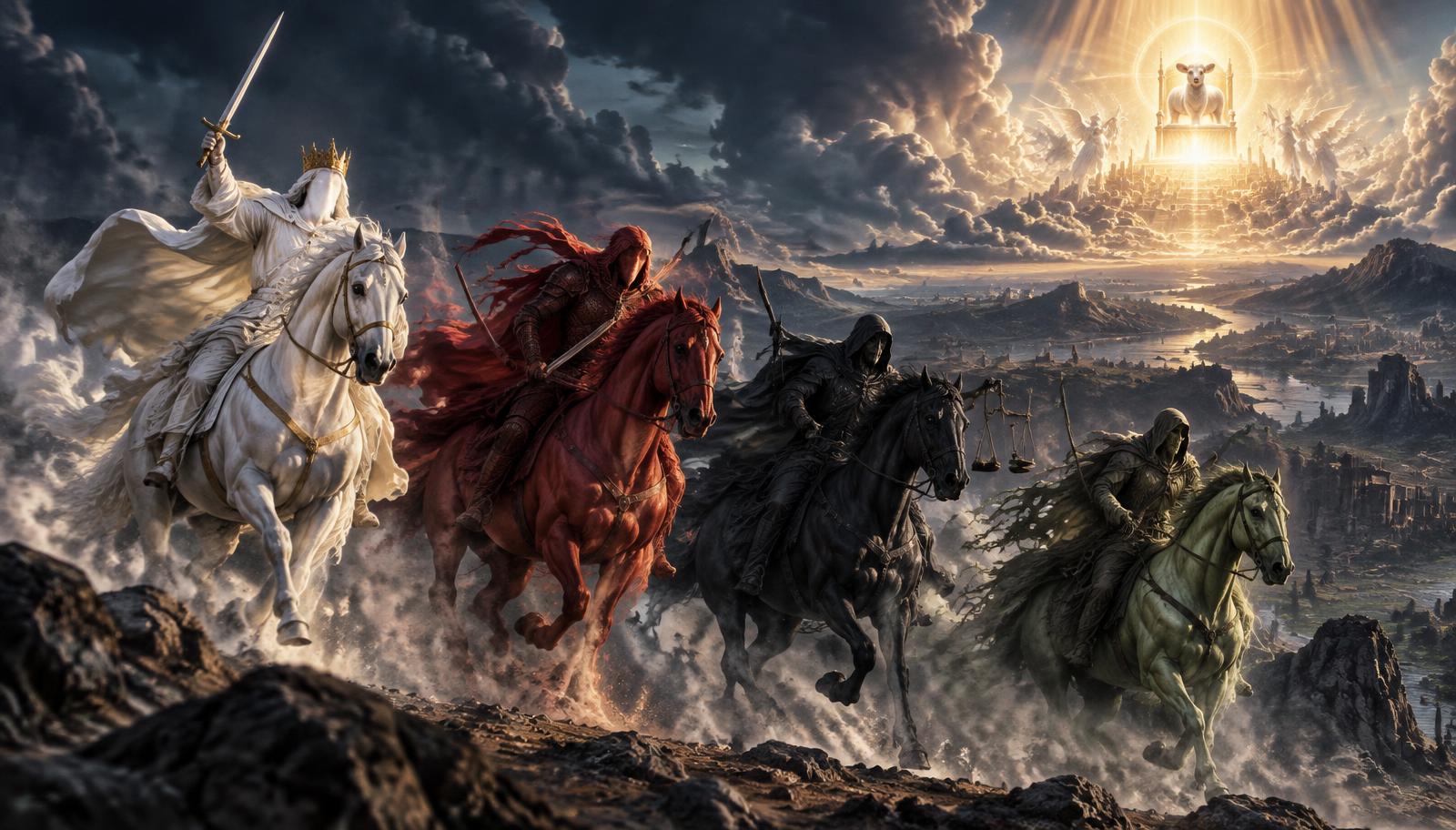
The four horsemen from Revelation are among the most famous and poignant images in the Bible. A white horse. A red horse. A black horse. A pale green horse. Conquest, war, scarcity, and death.
But whoever wants to properly understand Revelation 6 should not start with the horses.
They must begin with the Lamb.
For before John sees the four horsemen, he first gets a glimpse into the throne room of God in Revelation 5. There lies the key to understanding everything that follows.
Not the Horses, but the Lamb is Central
John sees a scroll in the right hand of Him who sits on the throne. That scroll is sealed with seven seals.
Then the question resounds:
“Who is worthy to open the scroll and to loose its seals?” — Revelation 5:2
Initially, no one is found worthy.
John weeps.
But then one of the elders says:
“Behold, the Lion of the tribe of Judah, the Root of David, has prevailed.” — Revelation 5:5
John looks.
But instead of a lion, he sees:
“a Lamb as though it had been slain.” — Revelation 5:6
There we see one of the deepest truths of Revelation: the Lion is the Lamb.
Jesus Christ does not conquer as earthly rulers conquer. He conquers through His sacrifice, His obedience, and His finished work on the cross.
Therefore, it resounds in heaven:
“You are worthy to take the scroll, and to open its seals.” — Revelation 5:9
Only after this does Revelation 6 begin.
That is fundamental.
The four horsemen do not appear independently.
The Lamb opens the seals.
The world has not slipped out of God's authority.
The First Seal: The White Horse
When the first seal is opened, John sees:
“a white horse, and he who sat on it had a bow; and a crown was given to him, and he went out conquering and to conquer.” — Revelation 6:2
Who this first rider precisely represents is interpreted differently.
Some see this as Christ or the spread of the Gospel. After all, white is associated elsewhere in Revelation with purity, victory, and heavenly glory.
Others see the rider as an image of military conquest, political power, or another conquering force within the judgments of the seals.
However, Revelation 6 does not name the rider.
Therefore, we must remain cautious.
What the text *does* say clearly is: he goes out conquering and to conquer.
In prophecy, an important principle applies: where Scripture speaks clearly, we may speak clearly. Where Scripture leaves room, we must remain humble.
The Second Seal: Peace Is Taken Away
Then a fiery red rider appears.
John writes:
“And to him who sat on it was granted to take peace from the earth, and that people should kill one another.” — Revelation 6:4
The rider is also given a great sword.
The meaning is poignant.
Peace is taken away.
Violence increases.
People turn against each other.
The red color strongly fits with war and bloodshed, but the meaning does not need to be derived from the color. The text explicitly states what this rider does.
Jesus also spoke in Matthew 24 of:
“wars and rumors of wars.”
And:
“nation will rise against nation, and kingdom against kingdom.”
There is a clear thematic correspondence between Matthew 24 and Revelation 6: war, disruption, famine, persecution, and death.
However, we must be careful not to directly equate every detail from both chapters one-to-one.
The Third Seal: A Day's Wage for Food
The third horse is black.
The rider carries a pair of scales.
“A quart of wheat for a denarius, and three quarts of barley for a denarius.” — Revelation 6:6
A denarius in the time of the New Testament was about a day's wage for a common laborer.
The image is therefore severe.
A full day's work barely yields enough food.
The scales point to scarcity, rationing, and exceptionally high food prices.
Wheat and barley were basic commodities. The situation John describes is not an image of economic prosperity, but of severe disruption.
Why Are the Oil and Wine Spared?
Then follows a remarkable command:
“Do not harm the oil and the wine.” — Revelation 6:6
Why are the oil and wine spared?
The text does not explain this.
Some interpreters see this as a limitation of the judgment. Others point out that certain agricultural products are affected while others are spared. Economic inequality has also been suggested as a possible explanation.
But we should not be more dogmatic than the Bible itself.
What is clear is: the judgment has limits.
Even in these poignant events, God remains sovereign.
The Fourth Seal: Death and Hades
The fourth horse is described with the Greek word *chlōros*.
This can indicate a pale, yellowish-green, or ashen color.
Not fresh and lively.
But sickly and deathly.
John does not leave us to guess who the rider is:
“And the name of him who sat on it was Death, and Hades followed with him.” — Revelation 6:8
The Greek word for the 'realm of the dead' is Hades: the abode or realm of the dead.
Next, we read:
“And power was given to them over a fourth of the earth, to kill with sword, with hunger, with death, and by the beasts of the earth.”
Here too is something important:
power was given to them.
Death is terrible.
But death is not sovereign.
A Strong Connection to Ezekiel
The language of Revelation 6 immediately evokes images from Ezekiel.
In Ezekiel 14:21, God speaks of four severe judgments: the sword, famine, wild beasts, and pestilence.
Revelation 6 names: sword, hunger, death, and wild beasts.
The similarity is striking.
John writes deeply from the language and imagery of the Old Testament.
Revelation therefore cannot be properly understood without books like Isaiah, Ezekiel, Daniel, and Zechariah.
Zechariah and the Colored Horses
The prophet Zechariah also saw different colored horses.
In Zechariah 1, horses appear in a prophetic vision.
In Zechariah 6, he sees four chariots with different colored horses going out over the earth.
The meanings are not automatically identical to those in Revelation 6, but the imagery is clearly related.
John is not writing in a vacuum.
Revelation breathes the Old Testament.
Conquest. War. Scarcity. Death.
When we read the first four seals together, an impressive sequence emerges:
conquest → war → scarcity → death
This does not necessarily mean that Revelation gives us a simple historical formula where one always directly causes the other.
But together, the first four seals form a devastating picture of a world where victory, violence, economic disruption, and mortality converge.
And yet there is one truth we must not miss:
the horsemen do not have absolute power.
Their power is given.
The Lamb opens the seals.
This does not mean that evil is unreal.
On the contrary.
War is real.
Famine is real.
Persecution is real.
Death is real.
But none of these powers stand beside God as His equal.
The Martyrs Ask for Justice
After the four horsemen, at the fifth seal, John sees the souls of those who had been slain for the word of God.
They cry out:
“How long, O Lord, holy and true?” — Revelation 6:10
That is a question believers have asked throughout the ages.
How long will injustice exist?
How long will evil go unpunished?
How long will it be before justice becomes visible?
It is noteworthy that the martyrs do not take vengeance themselves.
They direct their cry to God.
They entrust judgment to Him who judges righteously.
The Wrath of the Lamb
At the sixth seal, the earth is shaken.
There is a great earthquake.
The sun becomes black.
The moon becomes like blood.
People cry out to the mountains:
“Fall on us and hide us from the face of Him who sits on the throne and from the wrath of the Lamb!” — Revelation 6:16
The phrase 'the wrath of the Lamb' is striking.
A lamb evokes gentleness and sacrifice.
But the same Lamb who gave Himself for sinners is also the righteous Judge.
Jesus is Savior.
But He is also King.
Grace and judgment are not opposed to each other in Revelation as if God must choose between them.
The same Christ Who gave His life will ultimately judge evil righteously.
Jesus is the Heart of Revelation
Here lies perhaps the greatest warning for anyone who studies prophecy.
It is possible to be endlessly occupied with wars, 666, the antichrist, world politics, disasters, the four horsemen, and the great tribulation, and still miss the central subject of the book.
Revelation does not begin with: 'The revelation of the antichrist.'
But with:
“The Revelation of Jesus Christ.” — Revelation 1:1
Jesus Christ is the center.
The dragon is not sovereign.
The beast is not sovereign.
Babylon is not sovereign.
Death is not sovereign.
The Lamb is sovereign.
The True White Rider
Later, in Revelation 19, John sees a white horse again.
This time, the identity of the Rider is unambiguous.
“And I saw heaven opened, and behold, a white horse. And He who sat on him was called Faithful and True.” — Revelation 19:11
Verse 13 says:
“His name is called The Word of God.”
And verse 16:
“KING OF KINGS AND LORD OF LORDS.”
Here there is no doubt.
This is Jesus Christ.
Therefore, we should not automatically equate the first white rider of Revelation 6 with Christ.
Revelation 19 gives us the unmistakable Conqueror.
He is Faithful and True.
He is the Word of God.
He is King of kings.
Revelation Does Not End with Death
Revelation 6 is dark.
War.
Scarcity.
Martyrdom.
Judgment.
Death.
But the book does not end there.
In Revelation 21 we read:
“And God will wipe away every tear from their eyes.”
And:
“There shall be no more death.”
In Revelation 22, the tree of life appears again.
That is ultimately the story of Revelation:
judgment → victory → restoration → life
God makes all things new.
The Question for the Church Today
The most important question about Revelation is therefore not:
'Which contemporary event corresponds to which horse?'
The deeper question is:
'Will I remain faithful to Jesus when everything around me is shaken?'
The first Christians to whom Revelation was written knew persecution, political pressure, and economic uncertainty.
Some paid for their loyalty to Christ with their lives.
John does not constantly direct their gaze to Rome.
He directs their gaze to the throne.
He directs their gaze to the Lamb.
That is also our calling today.
When peace disappears: look to the Lamb.
When economic certainty falters: look to the Lamb.
When fear grips society: look to the Lamb.
When death draws near: look to the Lamb.
Kingdoms come and go.
Powers rise and fall.
But Jesus Christ remains.
Biblical Framework — The Four Horsemen at a Glance
White — Revelation 6:1–2: The rider goes out 'conquering and to conquer.' His exact identity is not named and is the subject of various interpretations.
Red — Revelation 6:3–4: Peace is taken from the earth. Violence and bloodshed increase.
Black — Revelation 6:5–6: The scales, the extreme grain prices, and the day's wage point to severe scarcity and economic disruption.
Pale Green — Revelation 6:7–8: The rider is named Death. Hades, the realm of the dead, follows him.
Most important key: the horsemen do not open the seals themselves. The Lamb opens the seals.
The Central Message
The four horsemen show the terrible reality of conquest, war, scarcity, and death.
But Revelation places all these things under the authority of the Lamb.
Therefore, the message of Revelation 6 is not that chaos has ultimately won.
The message is that even when judgment, war, scarcity, persecution, and death shake the earth, the throne is not empty.
The Lamb has not lost His authority.
Jesus Christ reigns.
And therefore, it resounds in heaven:
“Worthy is the Lamb who was slain to receive power and riches and wisdom, and strength and honor and glory and blessing!” — Revelation 5:12
Before John sees the horses, he sees the Lamb. And when the horses have passed, the Lamb is still there.
Worthy is the Lamb.
Related articles
Iran in the Bible: what Scripture actually says about Persia
Iran is not named in the Bible, but the land is. Persia, Elam and Media run through Isaiah, Ezra, Esther, Daniel and Ezekiel — and the way those texts are read still shapes how Christians talk about Iran today.
Jerusalem: Already a Jewish Majority in the Year of Herzl
In 1896, the year Theodor Herzl published "Der Judenstaat", Jerusalem already had a Jewish majority. A walk through the history of the city that all Jews consider their home.
Sa'ar: Israel will not base existential decisions on a UN majority
At the 81st UN General Assembly, Israel's foreign minister acknowledged the country is in a diplomatic minority but said security decisions must follow Israel's own existential interests.
Reader conversation
Comments
Checking your sign-in…
No approved comments yet.